
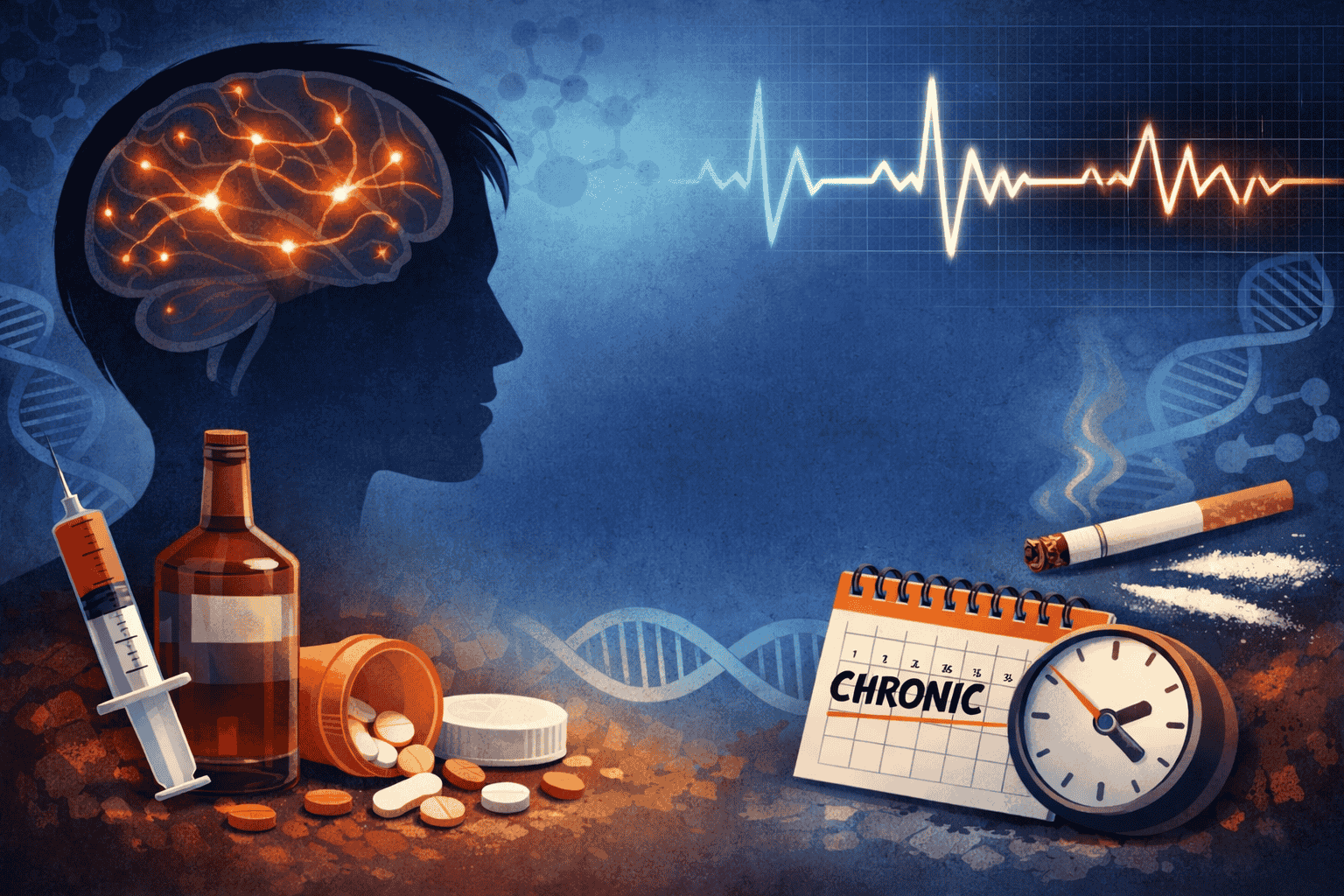
What is a Chronic Disease?
A chronic disease is a long-term condition that:
- Persists over time
- Often shows cycles of remission and relapse
- Requires continuous management
- Has biological, psychological, and environmental influences
Examples include:
- Diabetes
- Hypertension
- Arthritis
- Asthma
Addiction fits every one of these medical criteria.
What Is Addiction? A Clinical Definition
In medical terms, addiction is called Substance Use Disorder (SUD). This term comes from the Diagnostic and Statistical Manual of Mental Disorders (DSM-5), which is the official guide mental health professionals use to diagnose mental health conditions.
Addiction is characterized by:
- Compulsive substance use
- Loss of control over intake
- Intense cravings
- Continued use despite harmful consequences
- Significant impact on work, relationships, and health
It’s important to distinguish between:
- Use – Occasional consumption
- Misuse – Using in a risky or harmful way
- Dependence – Physical adaptation and withdrawal symptoms
- Addiction – Compulsive behavior and impaired control
Not everyone who uses substances develops addiction. Addiction occurs when repeated exposure changes brain function in ways that impair judgment, motivation, and self-control.
Why Addiction Fits the Chronic Disease Model
Addiction Causes Long-Term Brain Changes
Repeated substance use alters brain areas responsible for:
- Decision-making
- Impulse control
- Motivation
- Stress regulation
Addiction Has a Relapsing Course
Relapse rates for addiction are similar to:
- Asthma
- Hypertension
- Diabetes
Yet only addiction is often judged morally.
Genetic Vulnerability Plays a Role
Studies show that about 40–60% of the risk for addiction comes from genetics. This means some people are naturally more at risk because of the way their brain and stress system are built.
That’s why two people can use the same substance, but only one of them develops an addiction.
Environmental and Psychological Factors Contribute
Addiction develops through interaction between:
- Trauma
- Chronic stress
- Peer environment
- Mental health disorders
- Early exposure
This is known as the biopsychosocial model, further supporting addiction as a medical condition, not a choice.
Addiction Progresses Without Treatment
Untreated addiction often worsens over time, leading to:
- Physical illness
- Mental health disorders
- Relationship breakdown
- Occupational problems
- Legal consequences
Progression is a defining feature of chronic disease.
Why the “Moral Failure” Myth Is Harmful
Viewing addiction as a character flaw creates significant harm:
- Increased stigma
- Delayed treatment
- Shame and secrecy
- Family conflict
- Higher risk of depression and suicide
Shame often drives individuals deeper into substance use. Compassion, on the other hand, opens the door to recovery.
When families understand addiction as a chronic disease, they can shift from anger to support—and from punishment to partnership in healing.
The Brain Science Behind Addiction
Addiction and the Brain’s Reward System
The human brain is wired for survival. Activities that help us stay alive—like eating, bonding with others, and accomplishing goals activate the brain’s reward system.
At the center of this system is a chemical messenger called dopamine.
Dopamine plays a key role in:
- Motivation
- Pleasure
- Learning
- Reinforcement
When we do something enjoyable, dopamine is released, and the brain remembers that behavior as important.
How Substances Affect Dopamine
Drugs and alcohol can trigger dopamine release at levels much higher than natural rewards. For example, substances like opioids, nicotine, alcohol, and stimulants overstimulate the brain’s reward circuit.
Over time:
- The brain reduces its natural dopamine production.
- Every day pleasures feel less satisfying.
- The person needs more of the substance to feel the same effect.
- This process is called tolerance, and it is one of the early signs of addiction.
The Brain Learns to Prioritize the Substance
Addiction is sometimes described as a “hijacking” of the brain.
Normally, the brain ranks behaviors based on importance for survival. But repeated substance use trains the brain to treat the drug as a top priority, sometimes even more important than food, relationships, or safety.
This happens because addiction strengthens certain learning pathways.
The brain begins to strongly connect:
-
Places
-
People
-
Emotions
-
Stress
-
Certain times of day
That’s why cravings can be triggered simply by seeing a familiar location or feeling stressed.
Changes in the Prefrontal Cortex: The Self-Control Center
The prefrontal cortex is the part of the brain responsible for:
-
Decision-making
-
Impulse control
-
Planning
-
Evaluating consequences
Long-term substance use weakens this area.
As a result, a person may:
-
Struggle to resist urges
-
Make risky decisions
-
Continue using despite serious consequences
This explains why addiction is not just about “trying harder.” The brain’s control system itself becomes impaired.
Is Addiction Curable?
Addiction is not cured, but it is highly manageable, just like diabetes or asthma.
With proper care, many people achieve:
- Long-term recovery
- Improved quality of life
- Stable relationships
- Career success
Recovery is possible, but it requires continued support.